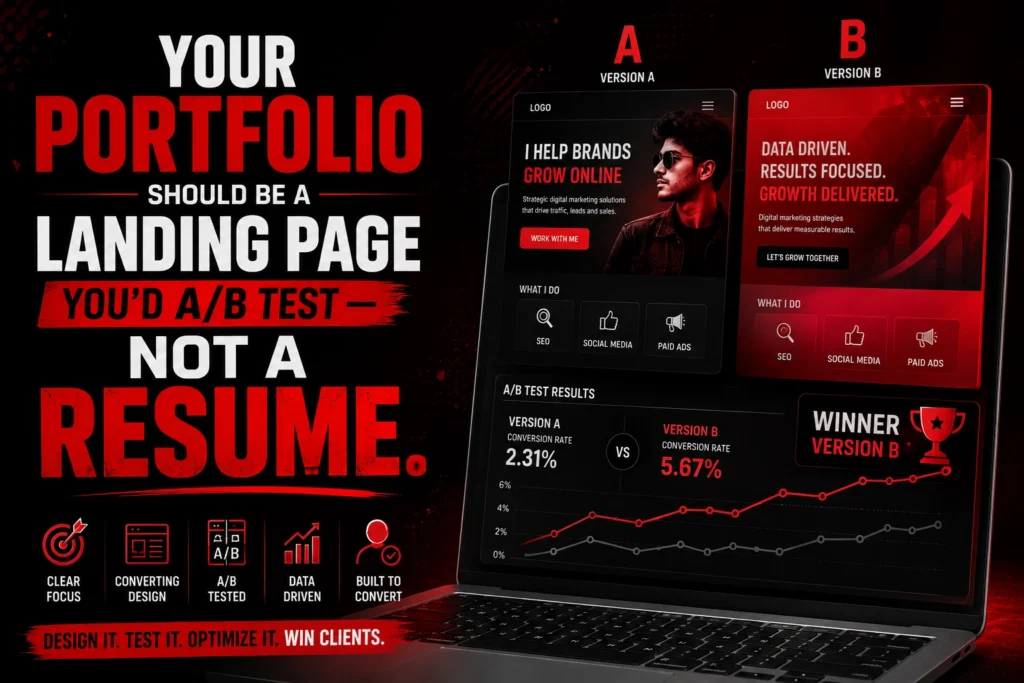
Your Portfolio Should Be a Landing Page You’d A/B Test — Not a Resume
Why High-Performing Digital Marketers Design Portfolios That Convert Visitors Into Clients 1.The Portfolio Mindset Has Changed Digital Marketing Portfolio Website In today’s competitive digital marketing industry, a portfolio is no longer just a collection of completed projects. Instead, it has evolved into a strategic marketing asset that communicates expertise, builds credibility, and encourages potential clients to take action. While resumes explain qualifications, portfolios demonstrate value through experience, results, and user experience. Therefore, professionals who continue treating their portfolios like static resumes often miss valuable opportunities to generate leads. Moreover, modern clients rarely spend several minutes reading lengthy biographies or educational achievements. Instead, they scan websites quickly and decide within seconds whether a professional appears trustworthy. Consequently, every section of your portfolio should guide visitors toward one objective: becoming your next client. A successful digital marketing portfolio functions like a carefully optimized landing page rather than a digital résumé. 2.Why a Resume Doesn’t Sell Your Expertise A traditional resume focuses primarily on employment history, educational qualifications, certifications, and technical skills. Although these elements remain important, they rarely convince a client to invest in your services. Businesses want confidence that you can solve their marketing challenges, increase visibility, and generate measurable business growth. Furthermore, resumes are designed for recruiters, whereas portfolios target potential clients, business owners, and decision-makers. Therefore, your portfolio should communicate solutions rather than simply listing accomplishments. Instead of saying you understand SEO, content marketing, or social media marketing, demonstrate how these skills created tangible outcomes. 3.Think Like a Landing Page, Not a Biography Landing Page Best Practiceshttps://blog.hubspot.com/marketing/landing-page-best-practices?utm_source=chatgpt.com Every successful landing page has one purpose—to encourage visitors to perform a desired action. Likewise, your portfolio should guide visitors naturally from curiosity to confidence before asking them to contact you. Instead of overwhelming users with unnecessary information, organize your content to answer the questions every client silently asks. For example, visitors want to know who you are, what problems you solve, how you solve them, why they should trust you, and how they can contact you. Therefore, every section should reduce uncertainty while increasing confidence. This approach reflects the principles of conversion rate optimization (CRO) and creates a more persuasive user experience. 4.Your Homepage Is Your First Marketing Campaign Your homepage represents your most important marketing campaign because it forms the first impression of your personal brand. Consequently, every headline, image, color, button, and paragraph should reinforce your professional identity. A weak homepage immediately reduces credibility, whereas a strategic homepage encourages visitors to continue exploring your work. Additionally, avoid generic statements such as “Welcome to My Portfolio.” Instead, communicate a clear value proposition that explains exactly how you help businesses grow. Headlines such as “Helping Brands Grow Through Data-Driven Digital Marketing” immediately establish relevance while strengthening your branding and personal positioning. 5.Every Section Should Have One Conversion Goal Many portfolios fail because every page competes for attention instead of guiding visitors toward one clear objective. Consequently, users become distracted, confused, and less likely to make contact. Instead, every section should support a logical customer journey. For instance, your introduction should build interest, your services should demonstrate expertise, your case studies should provide proof, your testimonials should build trust, and your contact section should encourage action. This structure mirrors successful landing page optimization strategies used by experienced digital marketers and significantly improves visitor engagement. 6.Why A/B Testing Should Guide Portfolio Design One of the greatest mistakes professionals make is assuming their first portfolio design is perfect. In reality, high-performing marketers continuously improve every digital asset through experimentation. Therefore, your portfolio deserves the same attention you would give a paid advertising campaign. A/B testing allows you to compare headlines, hero images, call-to-action buttons, service descriptions, layouts, and contact forms. Even small improvements can significantly increase conversion rates. Likewise, changing button colors, simplifying navigation, or rewriting headlines may encourage more visitors to become paying clients. Continuous testing remains one of the most valuable principles in performance marketing. 7.Showcase Results Instead of Responsibilities Clients care less about what you did and more about what you achieved. Therefore, avoid listing routine responsibilities that could apply to thousands of marketers. Instead, highlight measurable outcomes whenever possible. For example, rather than writing “Managed social media accounts,” explain that you increased engagement, improved website traffic, generated qualified leads, or enhanced brand visibility. Whenever possible, include percentages, graphs, screenshots, or campaign summaries. Data strengthens credibility while demonstrating your practical understanding of social media marketing, search engine marketing (SEM), pay-per-click (PPC), and digital advertising. 8.Build Trust Before Asking for Contact Trust remains the foundation of every successful client relationship. Therefore, your portfolio should establish credibility before requesting inquiries. Fortunately, there are many ways to accomplish this without overwhelming visitors. Case studies, client testimonials, certifications, project breakdowns, frequently asked questions, and professional branding all contribute to stronger trust signals. Additionally, displaying a consistent visual identity reinforces professionalism throughout your website. Consequently, visitors feel more confident contacting someone who appears organized, knowledgeable, and transparent. 9.Optimize Your Portfolio for Search Engines Even the most impressive portfolio cannot attract clients if nobody discovers it. Therefore, search engine optimization (SEO) should become an essential part of your portfolio strategy rather than an afterthought. Use descriptive page titles, optimized meta descriptions, relevant headings, internal linking, compressed images, and keyword-rich content. Additionally, publish valuable blog articles that answer common client questions while naturally incorporating keywords such as digital marketing, SEO, content marketing, online marketing, website optimization, and lead generation. Consistent publishing not only improves search visibility but also demonstrates industry expertise. 10.Use Content Marketing to Demonstrate Authority Your portfolio should educate as well as impress. Publishing insightful articles, case studies, marketing experiments, and industry observations helps position you as a trusted authority rather than simply another freelancer or consultant. Moreover, educational content creates long-term value because it continues attracting organic visitors long after publication. Every blog post strengthens your content marketing strategy while supporting your broader digital marketing objectives. As your knowledge base grows, so does your credibility among potential clients searching for reliable marketing professionals. 11.Design